
| Toil and Trouble . . . and Totally Worth It |
|
| Written by Margaret Evans, Editor |
| Tuesday, 08 April 2014 12:48 |
|
Jeff was living on Hilton Head at the time, having relocated from San Francisco, where he'd apprenticed as an actor with the Berkeley Shakespeare Company. I was living in Beaufort, the editor of the now-defunct Beaufort Magazine, serving on the board of the now-defunct SC Playwrights Festival. (Apparently, I'm a jinx.) Our board had contacted Jeff about producing a performance of staged Shakespeare readings as a fundraiser for the Festival. We met to discuss it over lunch at the old La Hacienda. Jeff was late and flustered – he'd had a flat tire – but also very cute, and the rest is history. We've been admitting impediments to this marriage of true minds ever since. (Sonnet 116, baby!) Jeff eventually moved to Beaufort, where he began producing Shakespeare – once, sometimes twice, a year – at USCB and in Waterfront Park. His company, Lowcountry Shakespeare, flourished for about a decade. Producing Shakespeare in a small southern town – even one as cool as Beaufort – is a Herculean task and a labor of love. It's difficult, time-sucking, very costly and not always widely appreciated. For ten years, Lowcountry Shakespeare was both the bane of my existence and a source of great joy and pride. I eventually began acting in the plays, myself – how else was I going to see my husband now and then? – and the friendships I developed on those productions are precious to me to this day. An English scholar in my former life, I had only ever approached Shakespeare's plays as literature – something to be pored over, poked at, and parsed – and engaging with them on stage, the way they were meant to be engaged, was a thrill and revelation. It was also a chance to see my husband in his element: juggling a thousand balls at once, making himself (and me) crazy, then somehow – at the last possible minute – magically bringing it all together in a seamless work of beauty. Always the producer, he was sometimes also the director, the set builder, and one of the actors. In fact, the last time Macbeth was produced in Beaufort, Jeff was Macbeth. And he was dazzling. We were still newlyweds at the time, and I remember watching him on stage opening night, just dumbstruck, thinking, "Who is this man I married? I don't even know this person." At the risk of sharing too much information . . . our daughter was born about nine months later. Never doubt that Shakespeare is sexy. That was almost 13 years ago, and I am happy to report that there's a new (sexy) Macbeth in "The standard idea of the Macbeths is that you've got this hapless, hen-pecked guy who's driven to do all these terrible things by his horrid, shrewish, power-crazed wife," says Jeff. "What tends to get missed is that, underneath all that, these are two people who really love each other. This is a love story. Santiago and Erin are bringing that love story to the forefront... they're bringing something really sexy to this show, and it's pretty cool because it deepens the story." Much of that "deepening" can be attributed to the play's director Debra Charlton, who recently moved to Beaufort from Texas. With a PhD in Shakespearean Performance and a long career, Debra has both directed and acted in many of the plays, along with teaching Shakespeare at the college level. In 2011, her production of Romeo and Juliet was selected to be performed in the UK on the Dell Stage of the Royal Shakespeare Company. Doesn't get much better than that. "Debra is bringing a level of professionalism to this production that Beaufort has never seen before," my husband Jeff tells me. "Shakespeare is what she does. She's been doing it for 30 years, and she's great at it." In a recent interview, I asked Debra if she ever gets bored with the Bard after all these years. Her reply? "Working with Shakespeare is like peeling an onion. Layer upon layer of new discovery. Always fresh and exciting." Academics and theater lovers alike seem to agree on this, which explains why the works of William Shakespeare are still so widely read and performed, four centuries after his death. I recently spoke with some Macbeth cast members about the challenges and rewards of performing Shakespeare. Most of these folks are amateur actors with families and "day jobs," and I wondered what had inspired them to commit to an endeavor that, in my experience, is more difficult and demanding than your typical community theatre production . . . which is difficult and demanding enough. Bill Dalton, who played Orsino opposite my Olivia a few years ago in Twelfth Night (and got to call me a "marble-breasted tyrant," a line we both still laugh about) has been cast in the role of Banquo in Macbeth. An English teacher at Beaufort Academy, Bill says that, for him, it's all about the language. "If everyone in the world spoke in blank verse, or better yet, rhymed pentameter like the lovers in Midsummer, all the time, I would be thrilled! By far the best thing about doing Shakespeare is getting to say the lines and to listen to your fellow actors say them. I walk around all year (at school) reciting lines from Shakespeare anyway, so it is just a bonus for me to have it serve an actual purpose!" But while the language is the reward, it is also the challenge. Dave Falls (Lennox) says, "You have to be sure you know your lines exactly as Shakespeare wrote them, and make sure the audience knows and understands what you are saying." Michael Kane (Seyton) concurs that the audience's understanding depends on the actors'. "The challenge is most certainly in interpreting the language and understanding the line structure and tempo. If the actor can successfully master that, then the words are understood by both the artist and the audience and their awesome beauty and 'sense' emerges." All the actors agree that Debra Charlton, with her immense knowledge and experience, has been great at helping them understand the language so they, in turn, can bring understanding to the audience. And understanding is crucial, because Shakespeare is about so much more than pretty language. More than just a consummate wordsmith, Shakespeare was an artist of authentic emotion and deep, universal insight. Bill Dalton agrees. I asked him if Macbeth had anything relevant to say to a 21st century audience, and he replied, "I could easily see it recast as a mini-series with the Thanes being senators, corporate executives, or even high ranking "captains" in a drug cartel. The issues the play raises are universal."
|
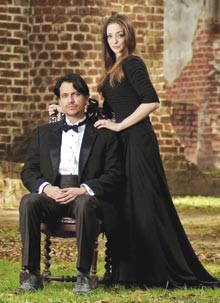
 town. Santiago Sosa has traveled to Beaufort from his home in Chicago to take on this role with the newly-formed company Shakespeare Rep. He's a professional actor with an MFA in theatre and countless Shakespearean roles on his resume. His costar Erin Dailey is a Julliard-trained Beaufort resident who's also done plenty of Shakespeare. On April 23rd, they will be joined by a cast of local actors – many of whom performed with Lowcountry Shakespeare back in the day – to celebrate the Bard's 450th birthday with a brand new production of Macbeth on the stage at USCB. My husband Jeff is producing – Me: "Just when I thought I was out, they pull
 me back in!" – and he assures me this isn't your grandfather's Macbeth.
 Debra is the founder and artistic director of Shakespeare Rep. She chose Macbeth as the company's debut production because it's one of her favorites and possibly Shakespeare's most accessible tragedy. It also happens to be one of his shortest plays, and Debra tells me she's employed additional editing "to make sure the story really moves."