
| Beyond the Mower |
|
| How Does Your Garden Grow? |
|
We are all familiar by now with this non-lawn use of grasses and their grass-like cohort, thanks in large part to the 20th Century designers Oehme, van Sweden, and Oudolph. The new plantings in the median of the Boundary Street redesign employ a number of strikingly handsome grasses. Perhaps the most striking – and maybe the most-used – is the needle-thin-leafed sweetgrass, Muhlenbergia. The plant trade uses various species names and varietal names for this native (M. capillaris; M. filipes; M. capillaris var. filipes; M. sericea), but it’s most frequently just called ‘muhly,’ pronounced “mule-ly.” Muhly grass (above) is most spectacular in the fall when it sends up great frothy masses of gossamer pink or white bloom, which glow with brilliant light when the sun is just right. Muhly grass is so spectacular that it risks becoming too common, I fear, used and overused sometimes in situations which fail to take advantage of its great usefulness and beauty. It looks great in the Boundary Street median. The native Little Bluestem grass (Schizachyrium scoparium, right) has wonderful blue color to its foliage, which in autumn may turn to shades of purple, red, and orange. Its very upright growth, its color and texture, and its use as a food source and as shelter for insects and animals make Little Bluestem suitable for a wide range of sites. My favorite of the native grasses is Indian Grass, Sorghastrum nutans. I love it because it is everywhere up near the farm in the upper coastal plain. It fills me with pleasure to spot the blue spears of its leaves each spring, and I watch as the plants fill long stretches along roadsides and offer statuesque blue clumps in a field of green. In September the now four foot tall plants begin sending up their bloom stalks, at the end of which a tightly-formed head of flowers begins to appear like a spear point. That’s when I get really excited, because there’s now only a short time before the inflorescence opens, and the beautiful head of individually insignificant little flowers appears. As the flower head matures, the tiny light brown flowers turn quite red, and the awns and other parts acquire a metallic gold sheen. When the sun is right, the sight is breathtaking . . . and, disappointingly, difficult to photograph. The pictures always appear flat and lifeless compared to the experience of seeing the plant in the sunlight. If you go shopping for these wonderful landscape grasses, always try local native-plant nurseries first. They’re the most knowledgeable, give the best advice, and have plants that are most likely adapted to local conditions. If you must search further, local nurseries who specialize in grasses would be best; sadly, big box stores often promote and sell plants which are poorly suited to local conditions and often are poorly equipped to provide good advice. |
 If you can get beyond the two-and-a-half inch high expanse of meticulously maintained lawn; if you can think more widely than St. Augustine, Bermuda, or Zoysia; if you can avoid being distracted by that substance still illegal in our state, although beloved by many; then open your mind to the vast family of grasses – especially native ones – suitable for use in the garden and in the landscape.
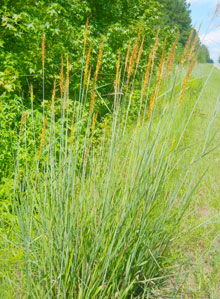 Indian Grass (left) has rarely appeared in my snooping in nurseries, but I do notice that the big national distributors are beginning to list it in catalogs. I have no doubt it will begin to be much more widely available.