
| Planning for the Future of Beaufort, Literally |
|
| Tuesday, 10 May 2011 16:28 |
|
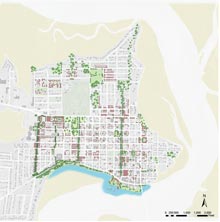
Last month, Beaufort’s newly formed, Office of Civic Investment presented the results of their week long charrette for downtown Beaufort. Represented were an exceptional range of ideas for infill, redevelopment and extension of the downtown core. The team offered proposals for where we build, what we build and how we build. Including both private and public sectors, they set forth alternatives to calm thoroughfares, celebrate the pedestrian, enhance existing and add new civic spaces, re-activate and grow commerce, and provide a broader range of dwelling options.
As the first of five sector plans, the process included in-depth research and inventory of the traditional building patterns of the sector and region. Also key was the inclusion of citizens and stakeholders, as well as public officials. The endeavor is to set a clear path and direction to revive the most successful settlement patterns, along with establishing new techniques to enhance and reinvigorate the sense of community that has sustained Beaufort for 300 years. Public participation is key to building a community consensus as the planning team continues to illustrate and codify the guiding principles for implementing Beaufort’s 2009 Comprehensive Plan.
The primary tool will be a Form Based Code. Current (Euclidean) zoning codes’ primary ob
Form Based Codes, on the other hand, focus on the public spaces formed by the physical characteristics of streets, blocks and buildings. By prescribing the type, size and disposition of these elements, growth locations and boundaries are established to create neighborhoods with discernible centers and edges with a mix of uses providing walkable access to work, civic and daily needs. Connected by networks of streets, thoroughfares, sidewalks and green ways, travel by foot, bicycle and public transit is fostered, reducing dependence on cars. Each neighborhood can be calibrated to preserve or establish a specific character of place appropriate to its urban to rural context, public will, and anticipated growth. Further, because this methodology requires buildings to respond to a their civic duty, not use, it encourages investment in more permanent buildings that can be used for many different purposes long into the future. The Bay Street buildings are great examples.
This is important work to ensure a vibrant future for Beaufort. But how? Keep in mind that a master plan sets a path for incremental growth towards a larger vision. 10-20 years is but a day in the life of a city; much like with planting a tree, we may see some fruit, but our children, and many generations thereafter, will reap the bounty. The proposals are many and wide-sweeping. Clearly questions of timing, feasibility and money come to mind. Particularly in the midst of a recession. But those answers will come...with time.
This article was written for Lowcountry Weekly by the Congress for the New Urbanism – Carolinas Chapter. For more information visit www.cnu.org
|

 jective is to regulate the specific uses of property, the separations thereof, and the vehicular connection of the uses. Terms such as Commercial, Industrial, Residential, and Rural are typical designations. Buildings are referenced as objects. Generally in terms of maximum yield, density, and required buffers from nature, corridors, and people.
 Coupled with a clear community vision, and enforceable supporting policy , time may be Beaufort’s most valuable asset. Even if resources were abundant, greatness seldom happens over night. Citing San Francisco and Chicago as examples, co-leader, Demetri Baches noted during the charrette presentation, “most of the greatest places were planned when there were no funds to implement.” Yet these, and many of the others, have blossomed into America’s greatest treasures. What sets these places apart is a clear focus on community experience, prosperity and delight; guided by principles based not on Use and Object, but rather Form and Place. This work, paired with the County’s efforts to implement a Form Based Code, will help insure that our city will evolve with intended results, and remain high on the list of most loved places.